Speed became part of the signal
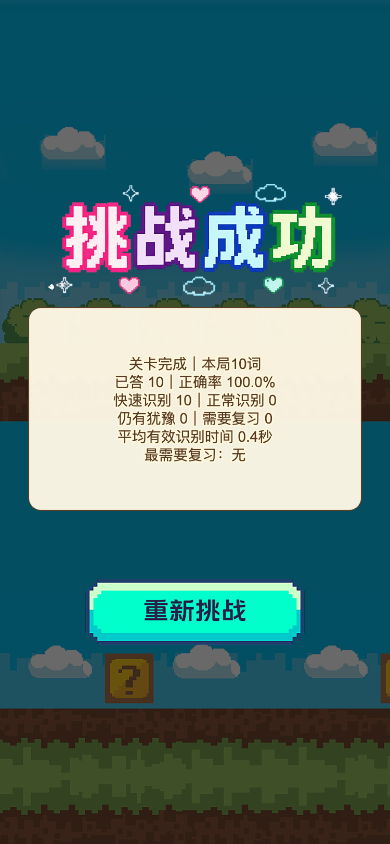
Results pair accuracy with FAST, NORMAL, HESITANT, and REVIEW classifications, average effective recognition time, and words needing the most review.
Educational product case study
A word-recognition platform built around a simple question: how can repeated practice become clearer, more focused, and more useful to students?
August 16–September 29, 2026 · Owner-reported records.
Practice accuracy: 57.6% → 80.5% · +22.9 percentage points, first vs. final 7 days. Source & context →
30-second overview
01 / The learning problem
Students may know the meaning of a word but still fail to recognize it quickly enough under time pressure.
Letter World began with a practical gap between knowing a translation and recognizing a word quickly in context. The product turns that gap into a focused practice loop rather than treating the game layer as the learning outcome.
Current release
Recognition speed, structured practice, and more useful feedback became part of the product loop.
Results pair accuracy with FAST, NORMAL, HESITANT, and REVIEW classifications, average effective recognition time, and words needing the most review.
Learners can choose 10, 15, 20, 25, or 30 words. Health scales with the selected round length.
Generation targets 25% easy, 50% medium, and 25% difficult questions using whole-question quotas. Available content can require adjacent-difficulty substitutions; a question does not repeat within one round.
Incorrect and hesitant words receive priority in later practice. A minimal learning-data workflow supports review of these signals.
The result screen goes beyond a simple score. During the question phase, the semantic image stays hidden until the answer is confirmed, then remains visible until the next question. Pre-learning cards remain a separate part of the flow.
V2.0 / Interface evidence
The results view brings accuracy, recognition classifications, average effective recognition time, and review words together.
This captured interface shows a ten-word automated verification round: 100% accuracy, 10 fast recognitions, and a 0.4-second average effective time. These values are synthetic test data, not a student performance record.
Later development / Local guest-playtest
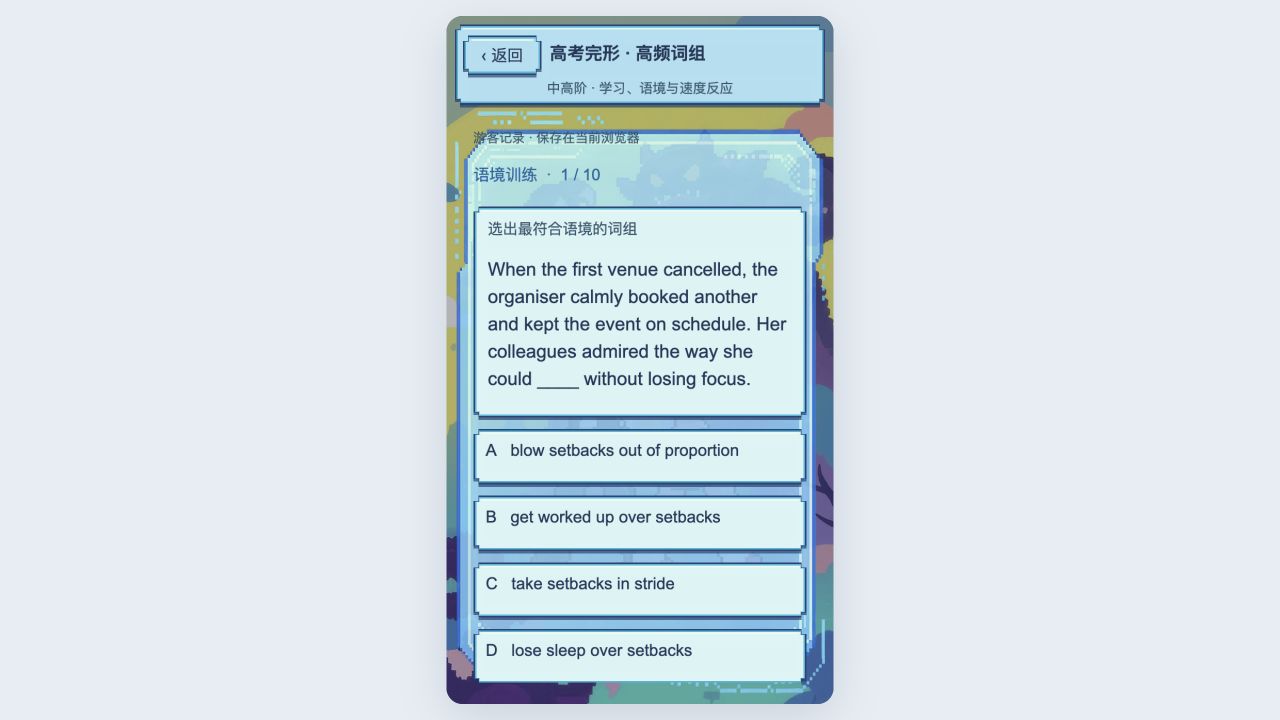
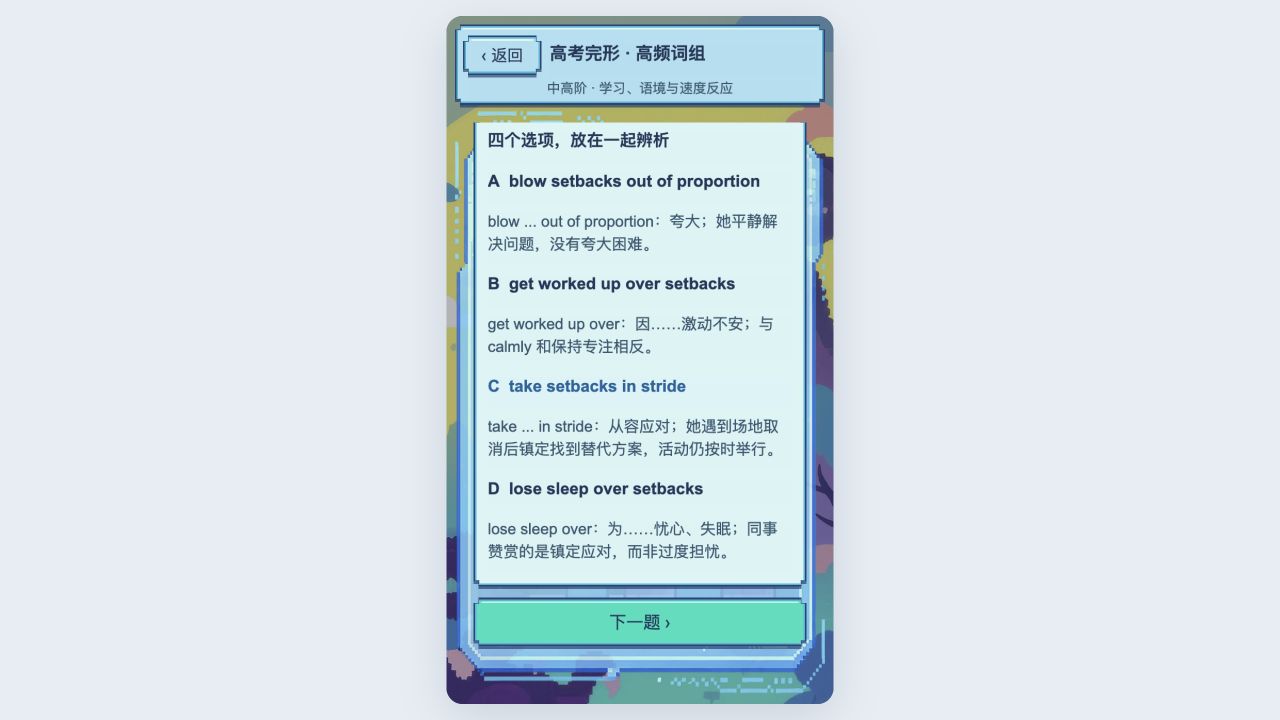
These October 2026 development captures show contextual phrase practice and explanations that compare the choices. They document the interface, not learning outcomes or a verified production release.
 View full size (opens in a new tab)
 View full size (opens in a new tab)
Selected screen recording / 30 seconds
A continuous excerpt from my phone recording: choose a word’s meaning, see visual feedback, and move through a practice round. It shows product interaction, not participant data or measured learning gains.
Original audio is available when you press play. English scene descriptions summarize the visible actions; they are not a speech transcript. The video does not load automatically.
Archive / V1.1 interface
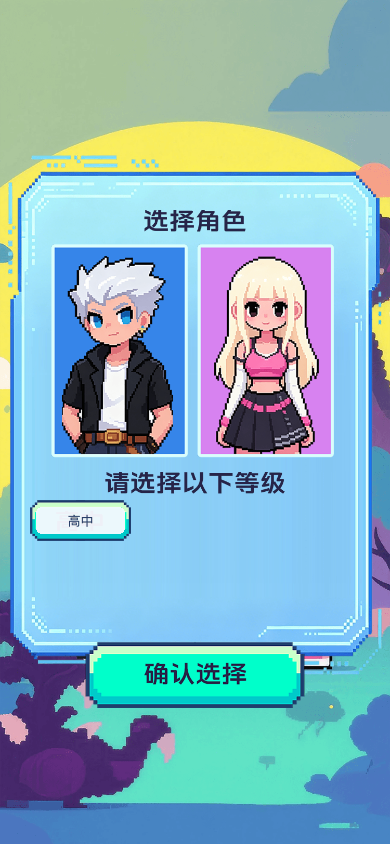
Earlier screens document the product’s previous stage; they are not presented as the current V2.0 interface.
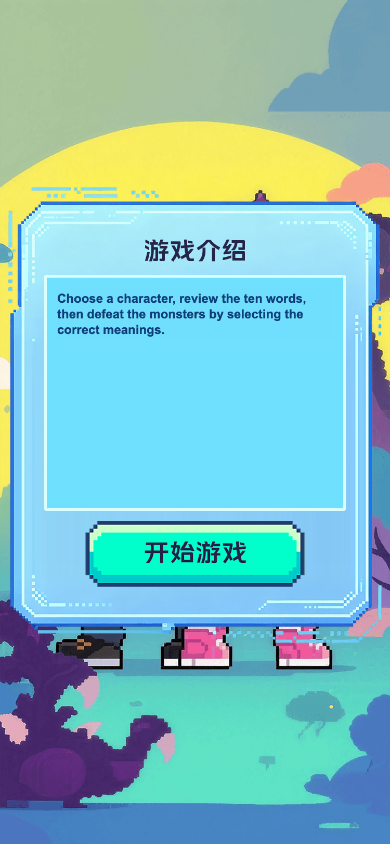
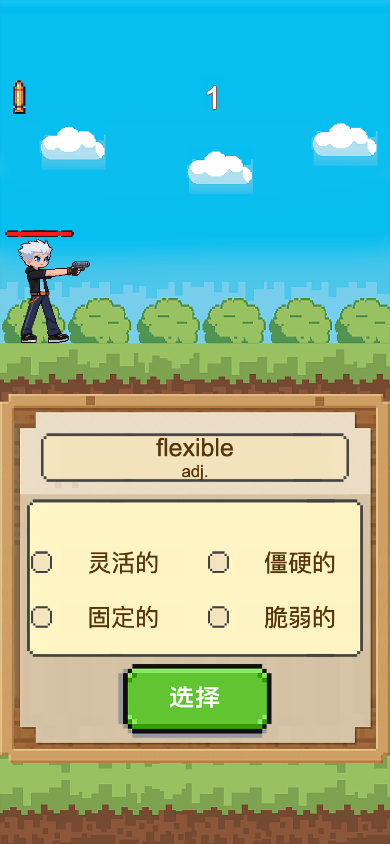
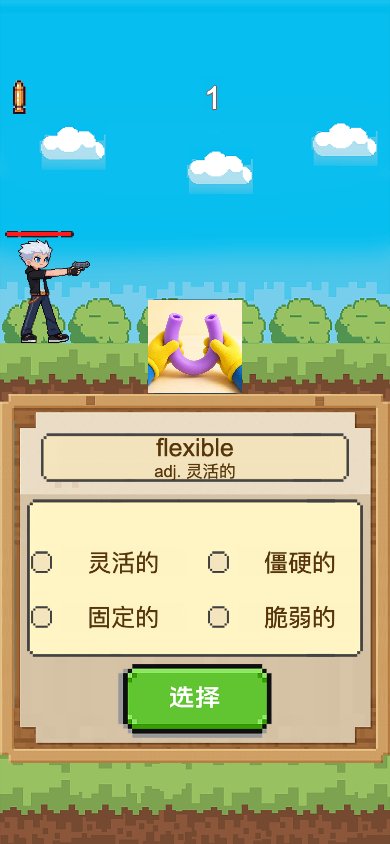
02 / Product concept
Letter World turns recognition practice into a short, repeatable loop: encounter a prompt, make a choice, receive immediate feedback, and return to difficult material. The product is designed to make repetition feel purposeful without hiding the learning task behind a large game world.
03 / My role
Founder and Product Lead: product direction, learning goals, implementation coordination, version testing, and feedback-driven iteration.
This role describes project initiation, product direction, coordination, testing, and iteration. It does not imply that I wrote every part of the engineering system alone.
04 / Development and iteration
“I gradually learned that a useful educational product did not need a larger virtual world. It needed a clearer and more repeatable learning loop.”
V1.1 brought the game client, question bank, content-management workflow, and a validated release artifact together. The archived V1.1 artifact is an earlier milestone. V2.0 is the current live release, as confirmed by the project owner; this website review did not independently probe the production service.
Established the client, content-management workflow, and repeatable learning loop.
Added selectable rounds, structured generation, recognition timing, review priorities, and anonymous aggregate learning-data administration.
05 / Earlier student feedback
In an earlier V2.0 feedback round, ten students tried the product on launch night and gave positive feedback. Across five consecutive school days, 18 classmates used it daily, each completing at least two rounds per day. Among those users, 10 specifically said that ten-word rounds suited short breaks, felt quick, and helped them notice words more readily. These historical observations are separate from the 308-student reporting window, not a measured learning gain.
These observations document real product use and qualitative feedback. They do not constitute a controlled study or demonstrate a measured improvement in academic performance.
Continuing vocabulary priorities from earlier feedback
Raise the difficulty of the high-school vocabulary bank.
Reduce overly simple foundational words in later selections.
Add high-frequency error-prone words and words with multiple meanings.
Include easily confused word pairs and difficult words common in reading.
Usage snapshot / Owner-reported records
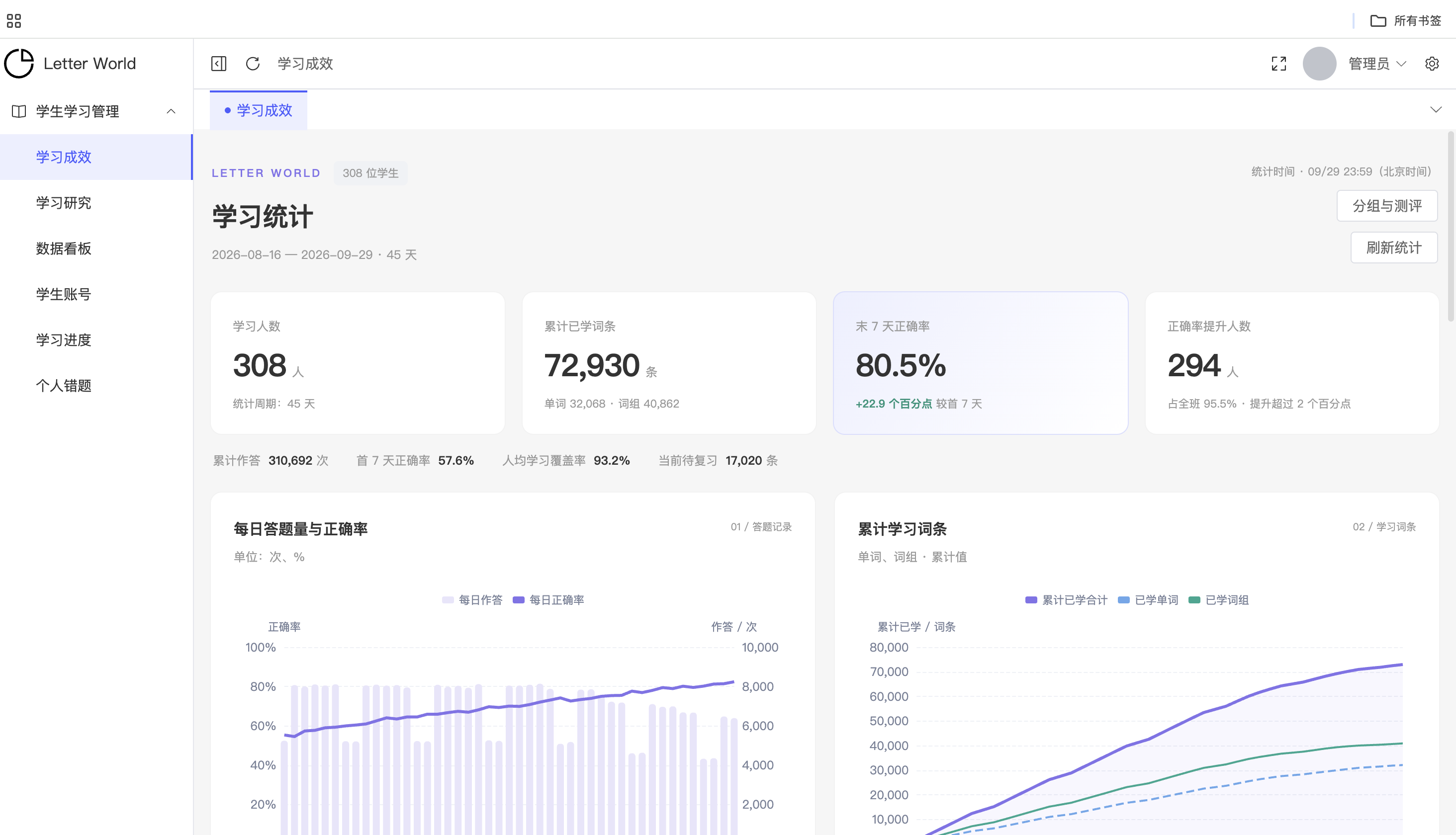
August 16–September 29, 2026. A 45-day view of participation and practice responses in the project’s admin dashboard.
+22.9 percentage pointsObserved change within the practice records
Source: project-owner-confirmed usage records, shown in the supplied admin dashboard screenshot. The underlying records have not been independently audited for this website.
 View full size (opens in a new tab)
These are practice-response statistics, not standardized English test scores or a controlled study. The change does not establish that Letter World caused a learning gain. This reporting window is separate from the 18-classmate feedback group described above; the counts are not added together.
06 / Technical system
The product connects a mobile learning experience with content management, application data, and a validation pipeline.
Mobile H5 game flow, questions, audio, images, and immediate feedback.
Question-bank review, editing, state changes, and publishing controls.
Multi-application API and published-section delivery to the learning client.
Draft generation, JSON-schema checks, quality validation, and local preview before import.
Verified stack: Cocos Creator 2.4.11, TypeScript, Vue 3, Vite, ThinkPHP 8, PHP 8+, MySQL, and a Python 3.10+ content pipeline.
07 / Reflection
Building Letter World changed how I think about educational technology. A feature can be technically complete and still create friction for a learner. Version testing made interface clarity, vocabulary quality, and repetition design as important as adding new systems.