Start with local evidence
Validate needs through consented, anonymized interviews, surveys, and observation before finalizing a kit.
Education access · In progress
An early-stage effort to design low-cost experiment kits and supporting materials for schools with limited laboratory access.
01 / Personal context
I was born in a rural area near Nanping and now study in Xiamen. During visits home, I noticed that students often encountered physics experiments mainly as textbook procedures rather than hands-on experiences.
The long-term goal is to design low-cost experiment kits and supporting digital materials that can work within real school constraints.
02 / Current status
The completed work forms a research foundation for a possible pilot. School implementation, a finished kit, and student-outcome evidence remain future milestones.
I also conducted preliminary conversations with three to four friends from Nanping about their experiences with physics learning and school experiments. These conversations provide exploratory local context rather than representative evidence for Nanping schools as a whole.
03 / Working digital materials
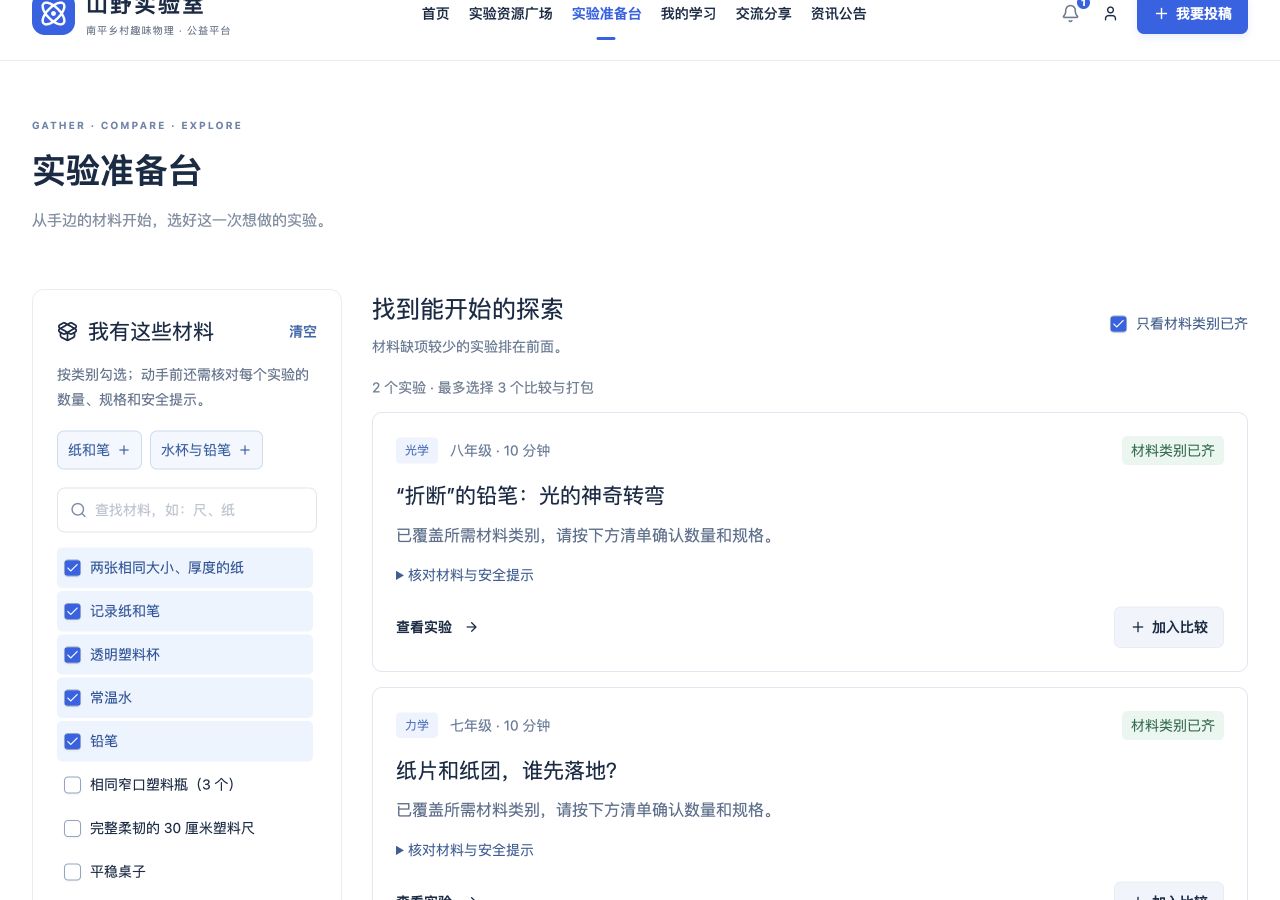
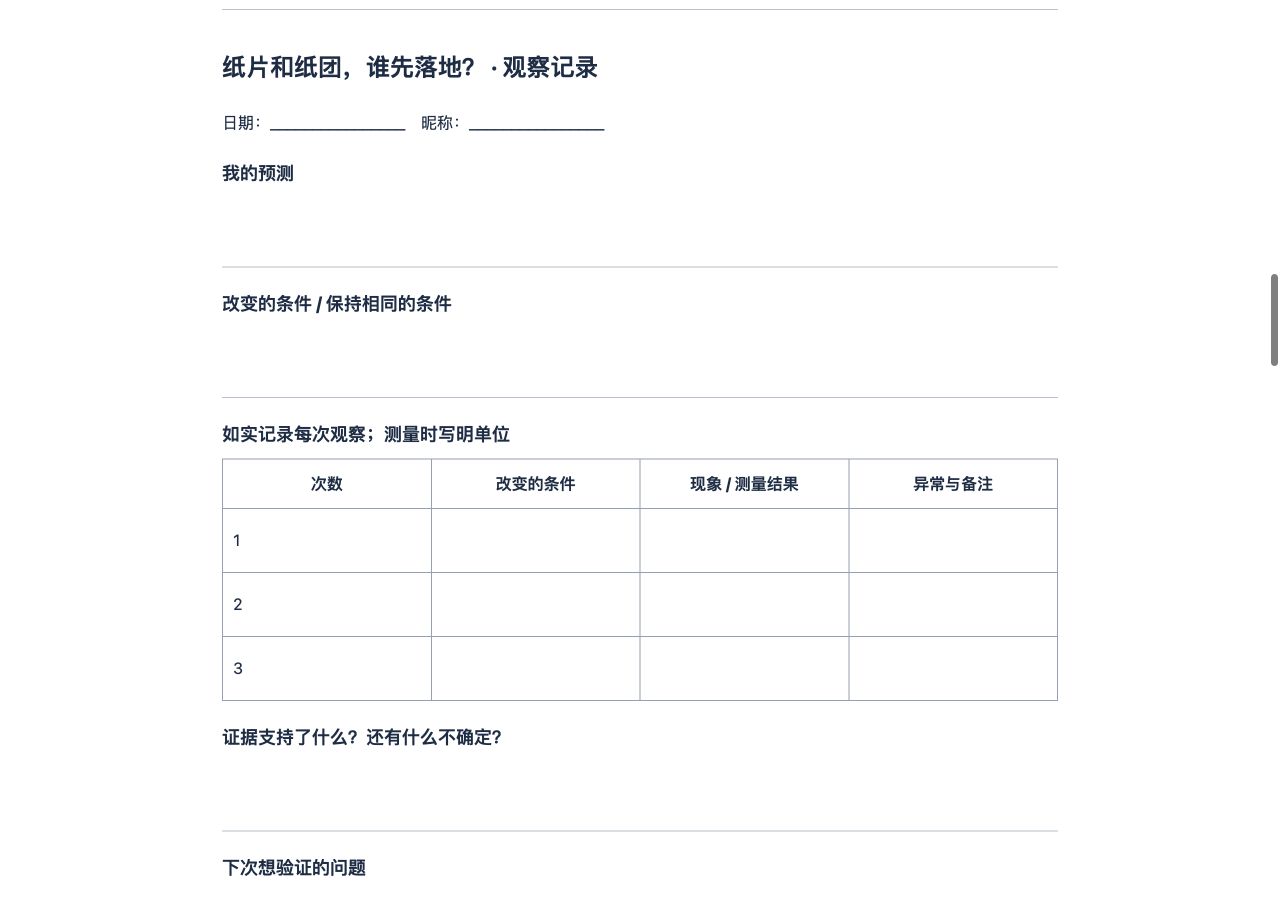
A preparation tool and printable observation prompts turn the research into materials that can be reviewed before a field pilot.
I built a digital preparation tool that starts with the materials a learner already has. It helps users find activities, compare up to three experiments, and prepare a text-only pack for offline reading or printing.
The pack keeps material lists, instructions, safety reminders, and blank observation prompts together. The prompts ask learners to make a prediction, record what they change and keep the same, and describe what their observations do—and do not—support.
 View full size (opens in a new tab)
 View full size (opens in a new tab)
These are working software materials, not a completed physical kit or a school pilot. These examples come from a local test session and a sample export in September 2026; they contain no actual student responses and do not demonstrate learning outcomes. Matching materials is not a safety approval, and external reference links still need an internet connection.
04 / Kit design principles
No locally validated bill of materials, safety review, completed physical kit prototype, or field-pilot evidence has yet been verified. These principles define the work that must come first.
Validate needs through consented, anonymized interviews, surveys, and observation before finalizing a kit.
Treat teacher usability, curriculum fit, supervision, and maintenance as core design requirements.
Favor accessible materials, clear instructions, offline support, and repeatable measurements.
Separate the planned intervention from completed work, and define success before a pilot begins.
05 / From research to pilot
The sequence keeps consent, anonymity, teacher ownership, and feasibility ahead of scale.